Thank you for reading and subscribing to this blog over the past few years. This is my final post here, but you can find more thoughts related to CRM, customers, sales, marketing, customer service, customer experience, social crm, and social business on my new blog at http://www.brianvellmure.com.
******************************************************************************
I will be phasing this blog at the end of December, 2011.
Please visit my new blog at http://www.brianvellmure.com
and subscribe to the new feed there. Thanks!
******************************************************************************
Speaking at an event hosted by SugarCRM and IBM Social Business this week, I informally polled the audience.
“How many of you are NOT on facebook?” No hands were raised.
“How many of you have a twitter account?” Most of the room raised their hands.
“LinkedIn?” Most of the room again raised their hands.
I repeated the same questions, referencing the people in the room’s businesses, and a slightly smaller number of folks raised their hands, but more than half still did.
I then asked – “How many of you know what to do with them?” Giggles. Laughter. Very few hands.
This is where we collectively find ourselves. It’s representative of a number of organizations that I have the opportunity to work with and speak to.
I didn’t even think of asking if any organizations in the room had created a tactical plan to listen and engage with customers and create a seamless (and amazing) experience across multiple channels and domains. Most companies are still trying to get the fundamentals right (as Filiberto Selvas pointed out here)
It’s easy to join a social network. It’s harder to engage. What should I say? What will they think? Do I have permission?
It’s even harder to engage with a coordinated strategy and accurately measure the results of your efforts. Blend activities on the social web with what’s happening in the rest of the organization…across departments…across silos?
If we’re not even on the same page internally, how can we communicate a unified message to the world that hasn’t been careful crafted by our marketing team and the agencies that they work with?
My anecdotal observation is that many companies get here and then acknowledge that it’s just too big of a challenge to tackle…at least for now.
“If you’ve got to start somewhere, why not here? If you got to start sometime, why not now?” – Toby Mac
New landscape.
New customer.
New roles.
New communication mediums.
New expectations.
New corporate culture.
New Focus.
New Critical Success Factors.
It’s quite a bit to digest when people are trying to keep their jobs and help keep the company profitable, when they’ve already just absorbed the jobs of 1-2 people who were laid off over the past few years. However, only focusing simply on the here and now is the path to extinction.
Those who understand how these new changes are affecting their marketplace (which in most cases is larger, more complicated, and more diverse than it was just a few years ago) will be hyper-rewarded. Those who fail to admit, understand, and adjust to these rapidly evolving new realities will be destroyed, or more likely die a long, slow, painful death.
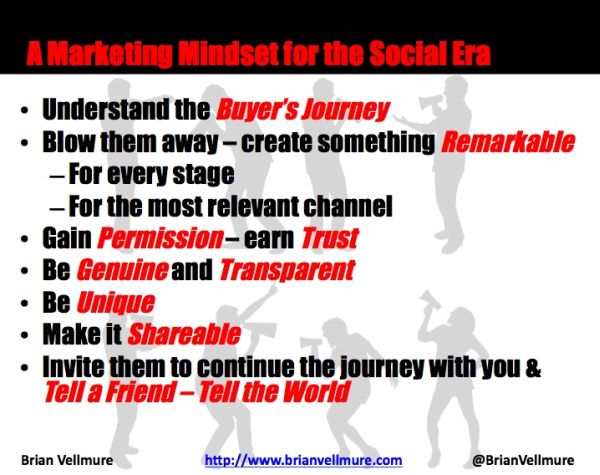
Below are a few highlights from the presentation.
FOUR THINGS TO FOCUS ON NOW
While there’s no notes or audio to the full deck, I’ve provided it below. Hopefully it provides value, and helps to stimulate some interesting conversations on the social web and for you in your respective organization(s). Interestingly, Mike Fauscette touched on many of the same themes in his blog post “Customer Service – the new Marketing in the era of the Social Customer”. It’s definitely worth a read.
One other final fascinating tidbit from the event was that I met and had a good chat with a Director of Marketing from a Silicon Valley startup. I meet and talk with plenty of Directors of Marketing. What was interesting about this one was that she said that she was actually a social anthropologist. My ears perked up. Seems like someone is paying attention. While the roles of social anthropologist and Director of Marketing may seem to be world’s apart, they’re not. Here’s a link to an article I wrote highlighting why it might be the perfect fit.
It’s fun to be part of the greatest transformation since the industrial revolution? Are you in?
******************************************************************************
I will be phasing this blog out soon. Please visit my new blog at http://www.brianvellmure.com and subscribe to the new feed there. Thanks!
******************************************************************************
Last week, at the Los Angeles Convention Center, Blog World Expo appeared in its fifth incarnation. I spent a couple of days watching, listening, and engaging with a dense concentration of experienced and enthusiastic new media evangelists.
However, the keynote address that arguably provided the most valuable insights and takeawys was provided by Shani Higgins, CEO of Technorati as she shared findings from Technorati’s “State of the Blogosphere” report.
Keynotes: Shani Higgings – State of the Blogosphere
I’ve pulled out some of the most interesting slides:
Passion, networking, and sharing are primary drivers behind what bloggers are doing, as evidenced in the slide above. One of the most interesting findings is that consumers prefer blogs for nearly every reason over news websites and mainstream media (see below). Overall, the passion and genuine pursuit of the interests of bloggers creates more trust and is the first place consumers go to learn about what interests them.
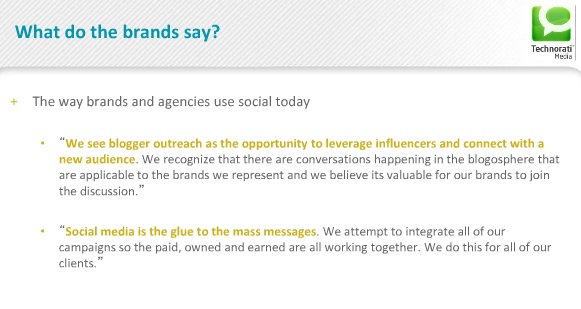
However, instead of becoming more genuine and passionate themselves, brands seem to still be operating in a 1.0 world seeing bloggers as individuals to be leveraged for the distribution of the brand message (see below). It will be very interesting to see if the social web genuinely evolves as the platform of the empowered customer, or if the major brands once again seek to control the channel for branded information distribution – an interesting mega theme for the next decade.
For an answer to the megatheme question asked above, you might find a clue by finding what some brands recognize “that there really is no such thing as message control”. One respondent envisions a world where “social media will act as a campaign leader, rather than a supporter”, and greater fragmentation will continue to emerge as a challenge for brands and advertisers.
The fact that only 4% of bloggers use blogging as their primary income and the average salary amongst full time bloggers is $24,000 may give pause to anyone looking to make the full time jump. However, for those who are interested in improving their blogging efforts and results, Darren Rowse offered some sage advice from one of the leaders in the blogging business.
If you’re interested in the full deck, you can find it here
Blogging from the Heart and Blogging Smart
Darren Rowse is known to many as ProBlogger. During his session, he shared a great blend of stories from personal experience, coupled with sage advice and best practices as how success in a blogger’s world comes from a perfect blend of blogging from the heart (fuel and find your passion), while also being smart enough to generate revenue and make it worth the time and effort involved.
The core theme of his presentation was that if you want to blog, or improve your blog, be passionate. He underscored his point by sharing a short anecdote from Robert Frost:
***********************
No Tears in the Writer
No Tears in the Reader
No Surprise in the Writer
No Surprise in the Reader
– Robert Frost
***********************
The more passionate you are, the more passionate your audience will be. However, a focus on engagement, monetization, and revenue will help sustain you over the long run, as countless hours of pouring your heart, soul, and mind into anything without any tangible return inevitably leads to burnout and disillusionment.
If you treat it like a business; set goals, know your readers, build your brand, create hooks, create great products, market effectively, and continually experiment, test and tweak your approach, then there is a place for you on the widening road filled with the next generation of citizen journalists, and the barriers to entry are virtually non-existant.
“Google+ is to Facebook what Macintosh is to Windows.” – Guy Kawasaki
Guy Kawasaki highlighted several reasons why he believes in the future of the newest social network, and he’s placing a big bet with his time.
He highlighted one striking difference between Google+ and Facebook: While Facebook is about connecting and sharing with those you know, Google+ is for discovering those you don’t quite know yet around topics of interest and passion. When Kawasaki got 50 intelligent comments on his first post, he nearly abandoned Twitter and has been putting in several hours each day manually reading, commenting, and sharing new stuff on Google+. His overarching view on the network currently is that it is a landgrab. He’s paying the price now to build his tribe. In return, to date, he has nearly 300,000 followers, partially do to the fact that he is a recommended user for those just signing up for the first time on Google+.
He likened Google+ today to Twitter in 2006, and Chris likes leveraging Circles functionality for segmenting those he is following. Circles gives the ability for users to narrow the stream based on topics and segmentation of users, whether you’re mutually connected with them or not. He also likes to push messages to certain circles. From my perspective, it’s a mechanism of targeted messaging, instead of blasting everything to everyone.
Another major consideration that both Brogan and Kawasaki mentioned is that Google search indexes Google+ content right away, while it does not index Twitter or Facebook posts. Brogan shared that his biggest piece of advice was to go back to your Google+ About page and work on your profile, as it will help you connect with others that are looking for what you can offer.
From my perspective, Google+ is early in its adoption. Today, it IS mostly filled with tech pundits, authors, speakers, and personalities. The masses aren’t on it yet, and don’t see a reason to be.
For those who understand the power of networks – connectors, marketers, and those that have or are trying to build strong personal brands, spending time on Google+ is a calculated bet that the company that intends to organize the world’s information will be able to layer Google+ on top and within a growing suite of ubiquitous tools and capabilities that reach deep into our lives (Google Apps, GMail, Android, etc.) The bet holds significant promise (as well as some risk) as the potential payoff will largely come down the road, if at all.
Giving Substance to Online Influence
One of my favorite sessions of the conference was led by Matt Ridings and Chuck Hemann and focused on the subject of influence. It’s a topic I’ve been giving quite a bit of thought to, over the past couple of years, and even more so recently, as shared in my recent post: “In search of: A meaningful measure of Influence” .
Online influence and reputation are two concepts that will become central to the way the world works over the next decade. Their session triggered some additional thoughts, which I’ll publish in a follow up to this post.
In summary
My observations and research indicate that there is plenty of confusion in the marketplace about what these new mediums mean for business. Most execs are interested in learning more about how trends in human communication are shifting, what it means at the macro scale, and ultimately what it means for their companies, and respective customer and prospect communities.
Today, most executives are swimming in a sea of noise and data, trying to grasp what these new realities really mean, how much weight and attention to give them, and how it should impact how they communicate within their organization and to their customers, suppliers, and other stakeholders.
The tectonic shifts under way not only require organizations to shift to listen to what their customers are saying, but also will allow those who truly understand how to leverage new media to gain market share by leveraging network effects that social channels provide.
Sadly, however, there appears to still be a significant gap between the evangelism taking place amongst the digerati and the understanding and support of executives. The conference had its share of valuable insights to be learned, but was also rich with hyperbole and ephemeral euphemisms that have no tangible connection to the core practicalities of business leaders today.
We are largely in an experimental phase, with some success stories emerging, but most case studies highlighting some very successful individual outliers, or celebrated measurements sitting on the fringe of significant tangible impact to the enterprise. We will begin to see this shift dramatically over the next 2-5 years.
While many business leaders seek to understand the new media and communication frontiers, many of the digerati who understand the channel and tools well, still struggle with connecting the dots to meaningful business value. Those that understand both and can bridge the gap between the two will be in high demand now and into the foreseeable future.
***************************************************************************************
I will be phasing this blog out soon. Please visit my new blog at http://www.brianvellmure.com and subscribe to the new feed there. Thanks!
***************************************************************************************
Influence. It’s a captivating word. It’s an alluringword.
We all want it, and we want to know others who have it.
In high school, if you could get the “cool kids” to the party, the rest would follow.
If the most famous and glamorous people in the world use it, like it, and talk about it, it must be great.
INFLUENCE: THE DEFINITION
But is that influence? From our good friend, Webster, Influence is:
1. A power affecting a person, thing, or course of events, especially one that operates without any direct or apparent effort:
2. Power to sway or affect based on prestige, wealth, ability, or position
WHO, THEN, ARE THE INFLUENCERS?
As part of a thought exercise, I asked myself two questions:
(1) Who are the most influential folks in history?
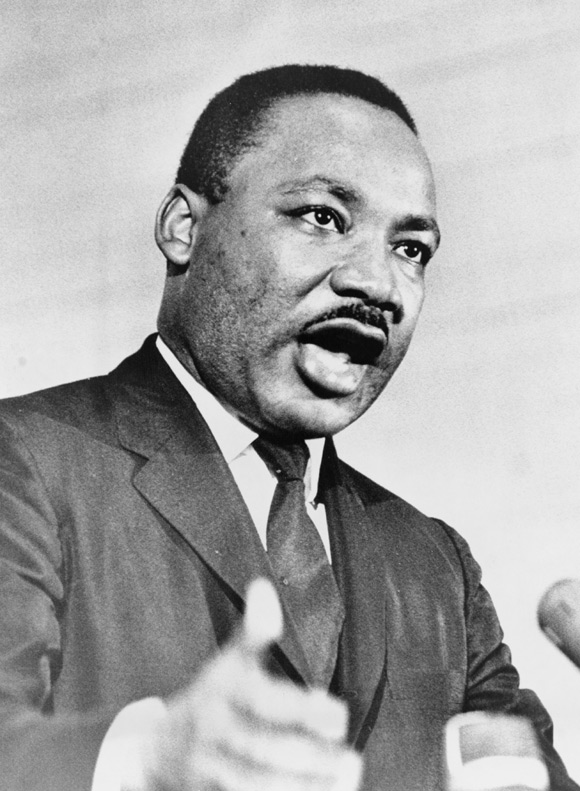
Names like Jesus, Nelson Mandela, Martin Luther King, Adolf Hitler, FDR, Mohandas Ghandi, Bill Gates, Warren Buffett, and Steve Jobs come to mind.
(2) Who have been the most influential people in my life?
My wife, my parents, a former NBC Universal Executive, a business man turned global missionary, the most successful enterprise sales executive I know, a Navy Seal turned pastor and non-profit Executive Director, and select football and basketball coaches throughout my athletic career.
The irony is that many or most of the most influential people in my life literally have no or limited presence on Social Networks (yet). There are dozens of others who influence my thinking as circles cascade outwards, and as contexts become more detailed and narrowly defined, but these are the ones who have spoken into my life, and who have the most influence on my decisions. Their actions and influence on my behavior is for all intents and purposes, not measurable.
THE “INFLUENCE” OF NETWORKS ON THE SOCIAL CUSTOMER
But I am also a social customer. I read reviews. I ask, comment, and interact in public social networks and forums, and these interactions and the things I learn and observe do influence my buying decisions.
WOMMA put together the following infographic about what fuels our collective purchasing decisions. These are the things that have marketers so excited and quite frankly, confused.
LEVERAGE AND THE DEMOCRATIZATION OF INFLUENCE
As the restricted and proprietary ivory towers of media, global communication, and information flow have given way to citizen journalists, we have witnessed the great democratization of media, celebrity status, and, in turn, the democratization of influence itself. Or have we? Has anything really changed?
In the end, business is all about leverage. It’s about maximizing the return on available time, talents, and resources. The social web, ubiquitous connectedness, and the ongoing digitization of everything finds marketers both forced and opportunistically looking to leverage the new influencers (their reach, their networks, and the trust that they’ve established in their tribe) for their respective interests.
Watch this short clip from a fascinating talk by Deb Roy and you’ll see a fantastic example of how an action by one can truly effect the actions of tens, or hundreds, or potentially thousands of others.
So, then, as marketers, the next obvious questions are:
How do we find the influencers?
How do we engage with them?
How do we entice them?
And, ultimately, how do we provide these influencers with a message that they can carry to their audience(s) that benefit our brand, our company, our products, and ultimately our interests?
FINDING THE INFLUENCERS
Who do we reach out to?
This first question is where most people start. Who are the influencers in our marketplace? The answer to that question, in and of itself, may be tougher than it initially seems. The unaware may start with their offline network, and extend their research by finding those with the highest number of Twitter followers. But studies have shown that there is little correlation to numbers of Twitter followers, facebook fans, or similar social network as measures of real influence.
Some online services have begun to tackle this problem by attempting to measure influence in a more scientific way. By now, you may have undoubtedly heard of Klout, or PeerIndex, or Traackr, or several other upstart influence measurement tools.
Are these valid?
Should they be used? And if so, how?
Does it help me identify the influencers who can allow me the greatest amount of leverage for distributing my message, and more importantly, help make a measurable impact for my organization?
THE EMERGENCE OF INFLUENCE MEASUREMENT SCORES
Klout, the most widely recognized service, recently stirred a sea of controversy when they changed their algorithm score. Perusing through the comments, it was apparent that some had so deeply embraced these influence scores, that they were literally upset that they might lose their jobs, their clients, and for a moment, I was concerned that many of them might even lose their lives.
While Klout’s messaging spun this as a “More Accurate, Transparent Klout Score”, I have to wonder. They’ve never been very transparent about the mechanics of what makes up the Klout score. While Klout started with Twitter, it has since expanded to Facebook, Google Plus, LinkedIn, and a host of other social sharing sites. At first glance, it appears that facebook, in particular, has taken on a far more significant weighting in their recent shift.
When trying to understand the motivations behind actions, I often start with the looking at the money trail. It’s important to know that Klout is a for-profit corporation with venture capital funding. It’s also important to know that they are monetizing their service by providing social data to large consumer brands. Alignment with the world’s most popular and mainstream social network probably makes sense and may contain the most valuable unstructured data for what has emerged as Klout’s primary paying customers, the world’s largest consumer brands. To their credit. it seems that Klout has perhaps taken a big step towards alignment with their customers in providing relevance. Perhaps I’ll no longer be the ideal candidate for pre-screening and behind the scenes previews for new release movies and TV shows, which I’ve received numerous Klout Perk offers for, ignoring all of them.
Is this really a measure of influence, and if so, in what context, for whom? Or is this simply a service that major brands can leverage to gain access to more targeted recipients of their ads?
How does this concept of influence measurement apply to the billions who choose to make significant changes in their communities, in their businesses, with their customers, and behind the walls of their organizations without doing so on public social networks? How will Klout or something like it really measure actions and communications that truly inspire change and affect thoughts, behaviors, and actions of others?
There is a long way to go. These fledgling measurement scores are valid experiments and I firmly believe the precursors to something more meaningful, more relevant, and more useful, but there is only so much they can measure today. Couple that with the extreme potential and propensity for inaccuracy and fraud, and the system’s reliability breaks down.
In closing, there are several challenges that the world of influence measurement must overcome before being truly valuable for organizations and brands. I’ll start with a few and let others weigh in.
(1) Klout (and other measurement tools) will act in their best interest. As long as their interests are aligned with profit, their is opportunity for corruption. Witness recent allegations against the major ratings agencies in the wake of the 2008 financial crisis for an example. (To be clear, I have no problem with Klout specifically, nor is this in any way any allegation against them)
(2) As evidenced by the video above, online personalities will act to game their score, something that has been proven to be easy to do. High “Influence” scores then have the potential to be allocated to those who have the most time on their hands to play an online game, then actually make any meaningful change or impact on the world.
(3) True influence is about changing behavior. It’s hard to measure anything truly meaningful today and correlate to something measurable (ie. a purchase, a referral or mention that led to multiple purchases)
(4) Measurement scores must be relevant to the motivations and priorities of the ones utilizing the scores.
(5) *** Perhaps the biggest one that will only be resolved with time and the eventual “digitization of everything”:
Only a small percentage of most of our actions happen in the digital world today. Though, this is changing rapidly , digital influence measurement systems can only evaluate a very small percentage of what’s happening in the real world.
THE REST IS UP TO YOU
I’m sure I’ve missed a ton so I’ll leave the rest to you.
What are some other challenges / gaps you see in today’s “influence measurement” scores? How would you improve them?
Or, maybe you can surprise me, what are some ways that you have used one of the emerging influence measurement systems to measurably impact the bottom line of your organization?
And if you still want more on the topic of influence, my friend Dr. Michael Wu has written quite a bit on the subject, especially as it pertains to social networks.
We are living in interesting times indeed. Geo-political revolutions, financial crises, economic uncertainty. Try as we might to ignore them, the fact is that the very fabric of capitalism is being re-evaluated, and perhaps even rewoven.
What we have assumed and known for at least 150 years is at the very least being questioned. Institutions that have spanned generations are now vulnerable.
Banks are still closing down weekly. The situation in Europe is increasingly fragile as previous whispers of dramatic austerity and potential collapse of the Euro become potentially viable outcomes.
In the United States, President Obama’s approval rating is at an all time low. Congress approval rating is at 14% – FOURTEEN PERCENT! – also an all time low.
Civil unrest has spread from oppressive dictatorial regimes in the Middle East and Africa to the developed world (see London riots).
Corporate America is obviously feeling the effects of many of these issues as they affect all of us, directly or indirectly.
You are likely familiar with the recent collapse of these famed organizations:
Lehman Brothers
Merrill Lynch
Blockbuster Video
Borders Bookstores
Power to the People
Friends, we are living in a unique era. While world leaders collectively wrestle with the greatest economic challenges in the last 70 years, many corporations find themselves doing the same. Customers are voicing their opinions about companies they do business with, as constituents voice their displeasure about the poor job their leaders are doing on their behalf.
The following incidents caught executives by surprise as specific cries against corporate actions rallied the hearts, minds, and activity of thousands in revolt against insensitive corporate interests.
What’s perhaps most interesting is that these recent revolutions and crises, whether political or corporate, are being fueled and enabled by the reach and connectedness of internet based social networks.
Surely, rapid uprisings and revolutions don’t just happen because someone tweets about it, or posts a YouTube video. It’s not the medium that really matters. It’s the ability for the message to spread, and for people to self-organize quickly – to out-think, out-flank, and out-number their oppressors or aggressors.
Revolution happens because a latent frustration finds an outlet. It happens because enough people unite and take action around an idea of change. Connected by a common interest or frustration, the network effect takes place as people unite in a flash mob around a common goal. It happens because the thought of things staying the same becomes more fearful and oppressive than the uncertainty and risk associated with standing up and going a different direction.
You see, I believe that there are tons of latent motivations out there that never turn into anything because the other two factors don’t exist. Social Networks and ubiquitous connectivity are providing the ability to actually do something once a trigger occurs. With latent motivations and now the ability to do something now in place, a trigger event becomes a spark that can quickly flame into a roaring fire.
In a world that is increasingly connected, increasingly digital, and access to anything and anyone is available in real time, corporate leaders should be considering the following questions.
The fabric of global society is transforming from a collection of lots of small, geographically connected groups to groups that are connected in a new geography that transcends previous space and time limitations.
Much of the new global infrastructure has been laid and it will continue to become more pervasive and more powerful.
People can now aggregate across boundaries, and organize beyond the constraints and management comforting silos. Al Quaeda and WikiLeaks quickly come to mind. In the same way, business units are self-organizing around the constraints of their IT departments.
Guess what? Our prospects and customers now have the ability to do the same.
The question every executive should be asking right now
So then the next question is, will your organization lead the next revolution in your marketplace, empowering and giving voice to the latent motivations of your customers, or will it become a victim of a more agile, more united group of customers who will self organize around their collective needs and jobs, leaving your outdated organization in their wake?
According to HootSuite, in the first 6 months of 2011, people clicked on links I shared on Twitter over 5,000 times. I have no idea how many links I shared. Below were the 9 most popular links (curious that the number one spot is from a blog post I wrote in early 2010)
February 12, 2010 by brianvellmure One of the worst snowstorms in the history of our Nation’s capital, the most flight cancellations since 9/11 (almost 6,000), and the closure and inaccessibility of a pre-booked venue were the circumstances surrounding BPT Partner’s Social CRM Certification Training, better known to the Twittersphere as #scrmsummit.
This event has already occurred. Please review the following post-event resources: Please join us for a roundtable teleconference on Friday, April 1, 2011 at 10am PT/ 1pm ET as we address the recent acquisition of Radian6 by Salesforce.com.
Paul Hagen is a Principal Analyst at Forrester Research, where he serves customer experience professionals. 8:03 AM Monday April 18, 2011 by Paul Hagen | Comments () [This post is part of Creating a Customer-Centered Organization.] The customer’s voice has a new champion sitting at the highest levels of power in companies.
An artificial heart and its lightweight power drive. A better airline for Brazil. Chocolate from Madagascar and a soccer shirt made of plastic water bottles. A fashion leader escaping its pattern, a smelter, and that little coupon startup in Chicago that’s suddenly worth billions. All this from one simple word: innovation.
The latest news involving social-media pioneers isn’t good. Pepsi has fallen to third place behind Diet Coke in spite of its widely heralded switch from Super Bowl ads to a huge social charity program called Refresh Project. Burger King has grilled through a couple of CMOs and fired agency Crispin Porter & Bogusky after producing Facebook campaigns and viral videos that got lots of attention while the business witnessed six consecutive quarters of declining sales.
Recently, we surveyed our users to better understand the effect Yammer is having on organizations. 10,000 users participated in the survey, and the vast majority of respondents found that Yammer helps people collaborate more easily and better engage with their coworkers.
Paul Greenberg, an expert on CRM, took time out to keynote the Radian6 user conference, Social 2011 (where I get my turn to speak this afternoon). After writing 800 pages on Social CRM, Greenberg’s not yet sure if it’s for real, which is similar to my far less informed perception.
If my grandchildren ever ask me where I was when I realised the internet was over – they won’t, of course, because they’ll be too busy playing with the teleportation console – I’ll be able to be quite specific: I was in a Mexican restaurant opposite a cemetery in Austin, Texas, halfway through eating a taco.
It’s been good to see old friends, meet new ones, and/or insert a handshake or hug into a previously only virtual relationship. The conference(s) also provided a great chance to check on the pulse of the industry, hear new stories, and generally get a broader and better sense for what’s going on the in the marketplace.
Like a room full of toddlers, the industry is learning to walk. There have been starts, stops, over compensations, disparity amongst players in general understanding and development, and in some cases, the harsh realization that we’re just not quite ready to do what we want to do.
1. Society, and therefore, the workplace is (still) evolving
This statement could have been (and was) written 5 years ago, but we’re early enough in the evolution that it’s still worth noting. The growth of a new wave of human communication, empowerment, and progress continues to move on. The pervasiveness of mobile and social technologies continues to expand geographically, and also more deeply penetrate individuals work lives in a continually blurred kaleidoscope of contexts.
2. Visions are still being cast, and re-cast
From my vantage point, the key tenets of social business benefits have been flushed out. While collectively most of us understand that a more efficient, more collaborative, more distributed way of living is coming, organizations and vendors alike continue to wrestle with what exactly that vision looks like in a tangible way. Tactical plans, and even organizational vision seems to be in a stage of frequent recalibration as more information emerges from the marketplace.
This, in and of itself, is one of the benefits of the realized benefits of a more collaborative culture. The shorter the feedback loop, the more opportunity for recalibration and alignment with stakeholder needs.
A major challenge facing operators on both the vendor and practitioner sides, respectively, is what feedback to take into consideration, and how to weight it appropriately. A similar dilemma faces stock traders; what is a meaningful movement versus what are short term fluctuations and what meanings and importance should be applied to myriad of elements flowing through the industry and customer firehose.
3. What’s the value?
Like any change initiative, WIIFMs are required. This is not different than any other technology powered advancement. While the broad based benefits of sentiment analysis, knowledge sharing, real time collaboration, and big data analytics are understood, the tangible benefit of social technologies will vary significanly for each organization, and quite frankly, each individual that interacts within its ecosystem.
Identifying the organizational goals, and coupling that with the perceived benefits of a wide audience of stakeholders is key to setting strategy, and establishing the corresponding tactical approach.
Questions like:
What’s the problem?
Who’s the customer (can be internal or external)?
What are they trying to accomplish, collectively and individually?
How do they do it now?
How can we make it better?
…and a host of other questions associated with the value creation process
…all still carry the same weight. I see the same high risk potential with the implementation and/or deployment of social technologies that we’ve seen with the introduction of ERP, CRM, Knowledge Management, E-Commerce, etc.
Business cases and value propositions are still necessary. ROI analysis may or may not be.
4. The customer is rising in importance and focus
One key thing that is encouraging is that conversations about the customer are gaining more prominence. Enterprise 2.0 had an entire track dedicated to sales and marketing that had good attendance. Kudos to Sameer Patel for putting the track together.
5. Enough thought leadership. It’s time to get to work.
Very few new ideas have emerged. New spins, new takes, new anecdotes are being spun, but very few epiphany inspiring ideas are being spread. As noted earlier, the key tenets of the next half decade have already been flushed out.Pioneers in the space are now beginning to have lessons learned stories to tell. Case studies warn of pitfalls and show how and where success has been realized.
In general, there is a growing sentiment of “there’s nothing left to say”.
6. Sales as a litmus test.
Sales has been the laggard in the adoption of social tools. In the front office, the two other musketeers, marketing and customer service, have more often capitalized on the use of social media, social networking, social crm, and social blah, blah, blah. While some may point to the sales guys and being technically less competent than some of the other workers in the organization, I point to another possible reason why the uptake has been slower to catch on.
No one else in the organization is as tightly tied to “pay for performance” than the sales team. Their butt is on the line daily. No one will be more resistant to employ useless strategies, tactics, and technologies than the ones whose compensation is as tightly aligned to their quarterly performance. If something is not helping them sell more, they are not using it. Their time is too valuable to work on non value-added toys. The end of the month is always just a few days away.
That said, more and more stories are emerging about global sales teams collaborating through Enterprise 2.0 tools, and/or individuals and teams from companies of all sizes using products like InsideView or OneSource to quickly access sales intelligence, partially leveraging data from the social web for this.
7. Empowering Human Movements
Whether we’re talking about political revolution, crowds self-aggregating for discounts, community members helping each other solve problems, or crowd sourced innovation, the common thread is that social technologies help to empower human movements. Social provides a platform where information and people can be searched for, identified, and harnessed for a specific purpose faster than any other time in history.
Social technologies help to empower human movements to achieve jobs of varying degrees; as small as responding to a question asked on LinkedIn, or as large as creating a hyper growth startup or overthrowing a government.
Summary
The mesh of Social CRM and Enterprise 2.0 philosophies, process and technology innovations continue to gain momentum, and are becoming more tightly entwined as the journey towards the pervasive emergence of the “social business”. At varying points of the journey, however, organizations with a strong established trajectory are realizing that success is elusive for those that do not have the fundamentals in place (collaborative culture, functional systems of record, solid change management practices).
The era of mass marketing, sales driven information gathering and sharing, and being “just good enough to win” is being shattered by the rapid emergence of a smart, networked, and increasingly demanding generation of empowered customers. In the fragmented and fast moving world of concepts, buzzwords, technologies, and applications, most executives are looking for looking for answers to a few basic questions:
– What matters?
– What’s different?
– How can I and or my organization benefit?
– Where is the opportunity?
– What should I do now?
As I survey the evolving landscape, there are four primary things that stand out as emerging keys to sales and marketing success in an always on, attention scarce, information rich world.
Growing your network
Sending signals that are valuable
Building a glowing reputation
Focusing on delighting your customers
None of these are new tactics. They’ve all stood the test of time and have been employed by folks over the last several hundred years. However, the speed and access to people and information has made each of them exponentially more important. Take a look at the stats in the image below.
*** TAKEAWAY ***: When buyers want something, they’ll turn to search and their network to look for answers. Make sure you are there.
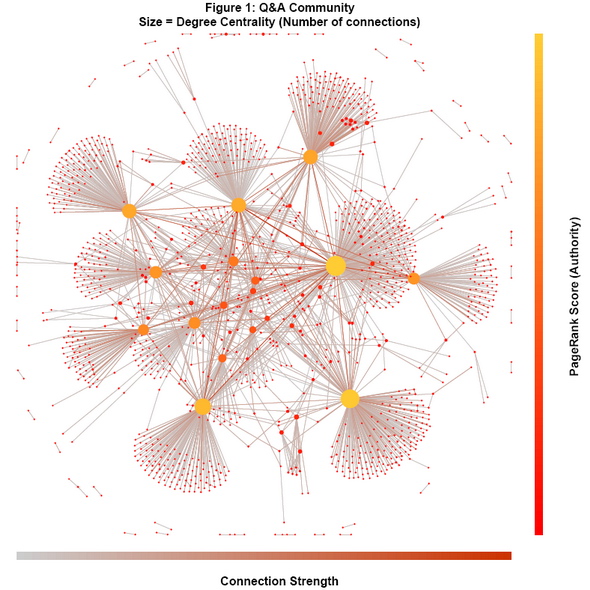
A great “human digitization” is taking place. Hordes of people and content are flooding into the web. Search engines and other content and people filters have to come up with a scoring mechanism to make results meaningful. Google, Bing, Facebook, and others are merging “people rank” with “page rank”. Search results are now being presented taking into account the “influence” and “reputation” of the messengers who are sharing it.
*** TAKEAWAY ***: Position yourself and your organization as a voice that matters (among those who know you, AND those who have yet to discover you)
*** How do you do this? ***
Build your network(s).
Send valuable signals – these could be blog posts, tweets, white papers, videos, comments, etc.
Focus on delighting your customers, prospects, partners, employees, suppliers, etc. It matters. It stands out. It breeds enthusiasm, loyalty, and word of mouth.
As your networks and signals expand their reach with positive sentiment, your reputation will increase.
As your reach and reputation grows, it provides an even greater platform to create moments of “delight”
Congratulations! An exponential and continuous feedback loop has been created.
For more on the concept(s), feel free to download/view the entire presentation below, or simply contact me directly.
There were once a bunch of frogs. They all jumped into a pot of water. You know how the story goes.
Except… in this case, it ends differently.
As the heat is slowly turned up, something happens. One of the frogs looks around, and actually notices the heat. He begins analyzing and forecasting what this rising temperature means for his future. He jumps out of the pot and encourages others to do the same. While the others are afraid of the risk of leaving, he is afraid of the risk of becoming extinct due to inaction.
As the last remains of an industrial era begin to warm towards a boiled extinction, Seth Godin repeatedly displays the uncanny ability to see the trends and encourage others to join him in the “revolution of our lifetime“. The greatest question remains how many will jump, unaware of what’s happening around us.
(My paraphrase) In a world where the speed of business cycles are exponentially increasing, there is no longer time to copy what others are doing. There is not enough time to imitate. Assemble the required inputs, create something remarkable with it, and distribute your art and ideas far and wide. The barriers to distribution are gone. CEOs, marketers, and well, everybody can take a lesson from this. But, the one catch is that you have to take initiative. Which, for many of us, is counter to everything we’ve been taught in school and in our jobs.
Shifts in technology and human behavior are rapidly changing customer’s expectations of companies. Things are moving so fast, that most executives are not only trying to catch up with the changes, but identify what some of the changes are. Understanding what those changes mean to each business is a more complicated matter altogether.
Ross Dawson brilliantly lays out his observations of the mega trends happening around us in the charts below.
Two growing and intertwining concepts (influence and reputation) are rapidly gaining ground and creating controversy as to their accuracy, adaptability, and use. There is a growing gap between those who believe that these scores and algorithms are the key to priority and leverage, opening up the door for profitable arbitrage, and others that believe that this is the emergence of a new caste system based on false measurements.
Just today, Klout just released a plugin for Twitter that displays an “influence” score (see the screenshot below), but this type of technology and scoring is currently in its infancy, and still marginally beneficial in the context of real life. However, some large and well known organizations are already giving perks and preference to customers with a high klout score.
Dr. Michael Wu, Chief Scientist, of Lithium Technologies, has been doggedly trying to uncover the meaning of influence, its impact on relationships, and ultimately corporate profit structures. Target the influencers, and you can move the crowd. There are seemingly vast opportunities in understanding and leveraging influencers within networked communities.
But, in reality, the influence/reputation conundrum is just one small movement in a massive tectonic shift happening that is disrupting geopolitical structures (Egypt, Bahrain, etc.), macro-economic theories and assumptions (the financial meltdown and the current response(s), human behavior, and corporate sustainability.
No1. From Individual Customers… to Networks of Customers
No2. From Customer Needs, Wants & Expectations… to Customer Jobs-to-be-Done
No3. From Company Value-in-Exchange… to Customer Value-in-Use
No4. From Delivering Value to Customers… to Co-Creating Value with Customers
No5. From Marketing, Sales & Service Touchpoints… to the End-to-End Customer Experience
No6. From One-Size-Fits-All Products… to a Long-Tail of Mass-Customised Solutions
No7. From Competing on Products, Price or Service… to Competing over Multi-sided Platforms
No8. From Company Push… to Sensing and Responding in Real-Time to Customers
No9. From Technology, Processes & Culture… to Complementary Capabilities and Micro-Foundations
No10. From Made by Companies for Customers… to Made By Customers for Each Other
No11. From On-premise Applications… to On-demand Solutions from the Cloud
No12. From Stand-alone Companies… to an Ecosystem of Networked Partners
No13. From Hierarchical Command & Control… to Collaborative Hybrid Organisations
No14. From Customer Strategy… to a Portfolio of Emergent Customer Options
No15. From Customer Lifetime Value… to Customer Network Value
Add to these, the fast growing mobile, always connected individuals, and you have the making of a perfect storm, for those who understand where things are headed.
Join the Conversation
On Wednesday, February 23, 2011 at 1 pm PST / 4 pm EST, please listen in to a conversation as some of the world’s brightest minds will evaluate and debate where we’re heading, project how multiple trajectories might collide, and what your organization should be preparing for now.
1) Influence and Reputation: How forward thinking companies will leverage these new measurements to attract and keep customers
2) Co-Creation: What it is and why it’s next in the evolution of customer centricity
3) The Impact of rapidly maturing mobile and collaborative technologies on organizations, their customers, and society as a whole
Here’s the call-in information – I hope you have the chance to join us:










 Brian Vellmure's CRM Strategies Blog
Recent Comments